
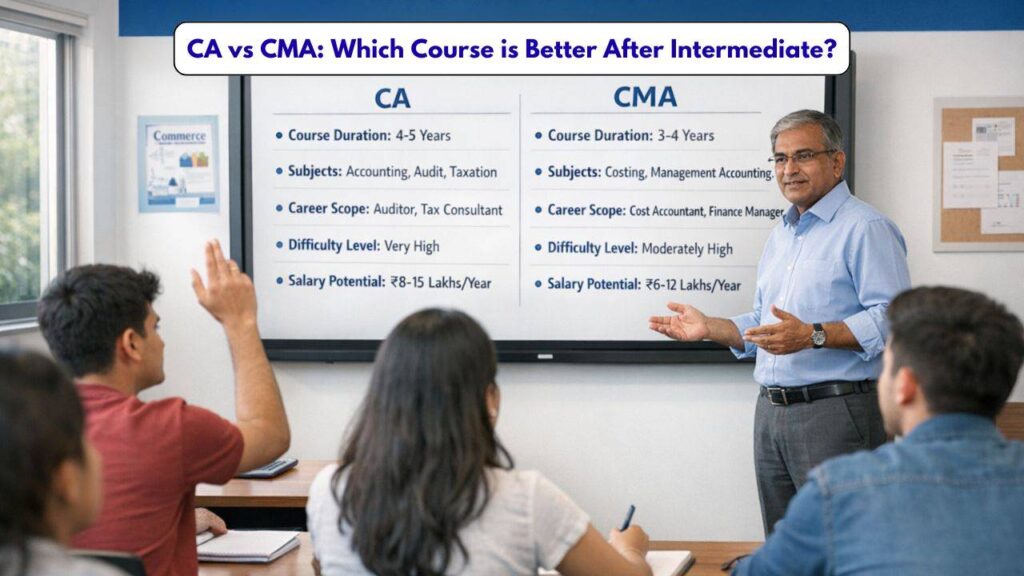
Choosing a professional course after intermediate (12th) is one of the most important academic decisions for commerce students. Among the leading professional choices in the finance and accounting domain are Chartered Accountancy (CA) and Cost & Management Accountancy (CMA), both known for their strong career value and industry recognition. But the common question remains: CA vs CMA: Which Course is Better After Intermediate?
Both courses offer strong career prospects, professional recognition, and long-term growth. However, the right choice depends on your interest, aptitude, and career goals. At Santhosh Commerce Academy, students receive structured guidance to evaluate their strengths before selecting a professional path.
This detailed guide will help you understand CA vs CMA: Which Course is Better After Intermediate? by comparing syllabus, difficulty level, career opportunities, earning potential, and skill requirements.
Before comparing benefits, let’s understand what each course focuses on.
1. What Is CA?
Chartered Accountancy focuses on:
Financial accounting
Auditing
Taxation
Corporate laws
Financial reporting
CA professionals typically work in auditing firms, taxation consultancies, and corporate finance departments.
Students interested in pursuing CA can explore structured training programs like
to build strong fundamentals
2. What Is CMA?
Cost & Management Accountancy focuses on:
Cost accounting
Financial planning
Cost control
Budgeting
Performance management
CMAs often work in manufacturing industries, corporate finance departments, and management accounting roles.
Understanding these core differences is essential when evaluating CA vs CMA: Which Course is Better After Intermediate?
3. Course Structure Comparison
CA Course Levels:
CA Intermediate
CA Final
CMA Course Levels:
CMA Foundation
CMA Intermediate
CMA Final
Both courses include practical training (articleship or internship), which enhances real-world exposure.
4. Difficulty Level
Why CA Is Generally Regarded As A More Demanding Qualification
Extensive syllabus
Low pass percentage
Complex taxation and audit subjects
CMA, while challenging, is more focused on cost and management accounting, making it slightly specialized.
If your strength lies in auditing, law, and taxation, CA may suit you better. If you enjoy costing, budgeting, and financial planning, CMA may align better.
This clarity helps answer the question: CA vs CMA: Which Course is Better After Intermediate?
5. Career Opportunities In CA
CA professionals can work as:
Auditors
Tax Consultants
Financial Advisors
CFOs
Corporate Accountants
They can also start independent practice after qualification.
Students aiming for CA often continue to strengthen subject knowledge early.
6. Career Opportunities In CMA
CMA professionals typically work as:
Cost Accountants
Financial Analysts
Budget Analysts
Internal Auditors
Management Consultants
CMAs are highly valued in manufacturing and corporate sectors.
When comparing CA vs CMA: Which Course is Better After Intermediate?, career preference plays a key role.
CA vs. CMA: Which Course Is Better After Intermediate? Based On Salary & Growth
7. Salary Expectations
Entry-level salary varies based on skills and organization. Generally:
CA professionals often earn higher starting packages in audit and taxation firms.
CMA professionals receive competitive packages in corporate finance roles.
However, long-term salary growth depends more on expertise and experience than just qualifications.
8. Global Recognition
CA qualification has strong recognition in India and partnerships with international bodies.
CMA also has growing international relevance, especially in corporate sectors.
Understanding global mobility is another factor in deciding CA vs CMA: Which Course is Better After Intermediate?
9. Choose CA If You:
Enjoy auditing and taxation
Are comfortable with legal provisions
Can handle detailed financial reporting
Prefer independent practice opportunities
10. Choose CMA If You:
Enjoy cost analysis
Like budgeting and performance evaluation
Prefer corporate management roles
Want to specialize in financial planning
Self-awareness is critical when deciding CA vs CMA: Which Course is Better After Intermediate?
There is no universal answer to CA vs CMA: Which Course is Better After Intermediate? The better course is the one aligned with your strengths and long-term goals.
If you aspire to become an auditor or taxation expert, CA may be the right path. If you are interested in cost control, budgeting, and corporate finance, CMA may suit you better.
What matters most is structured preparation, consistent effort, and expert mentorship.
Confused about choosing CA or CMA? Speak with experienced academic mentors who can guide you based on your strengths and career goals.
Contact us today Make an informed decision for a successful professional future.
Both courses are challenging in their own way. CA is often considered broader and more rigorous, while CMA is more specialized in cost and management accounting. The right choice depends on your interest and strengths.
Yes, some students choose to pursue both qualifications. However, managing both requires strong time management and academic discipline. It is often better to focus on one course initially.
Both CA and CMA offer strong career prospects. CA provides opportunities in auditing, taxation, and independent practice, while CMA is highly valued in corporate finance, costing, and management roles.
Students who are interested in auditing, taxation, financial reporting, and corporate laws may find CA more suitable for their career goals.
Students who enjoy cost analysis, budgeting, financial planning, and performance management may find CMA a better fit for their skills and interests.
Santosh Commerce Academy is a trailblazer in redefining business and commerce education in Hyderabad.
Quick Links
Contacts
© 2026 Santosh Commerce Academy. All Rights Reserved By Web Rocz